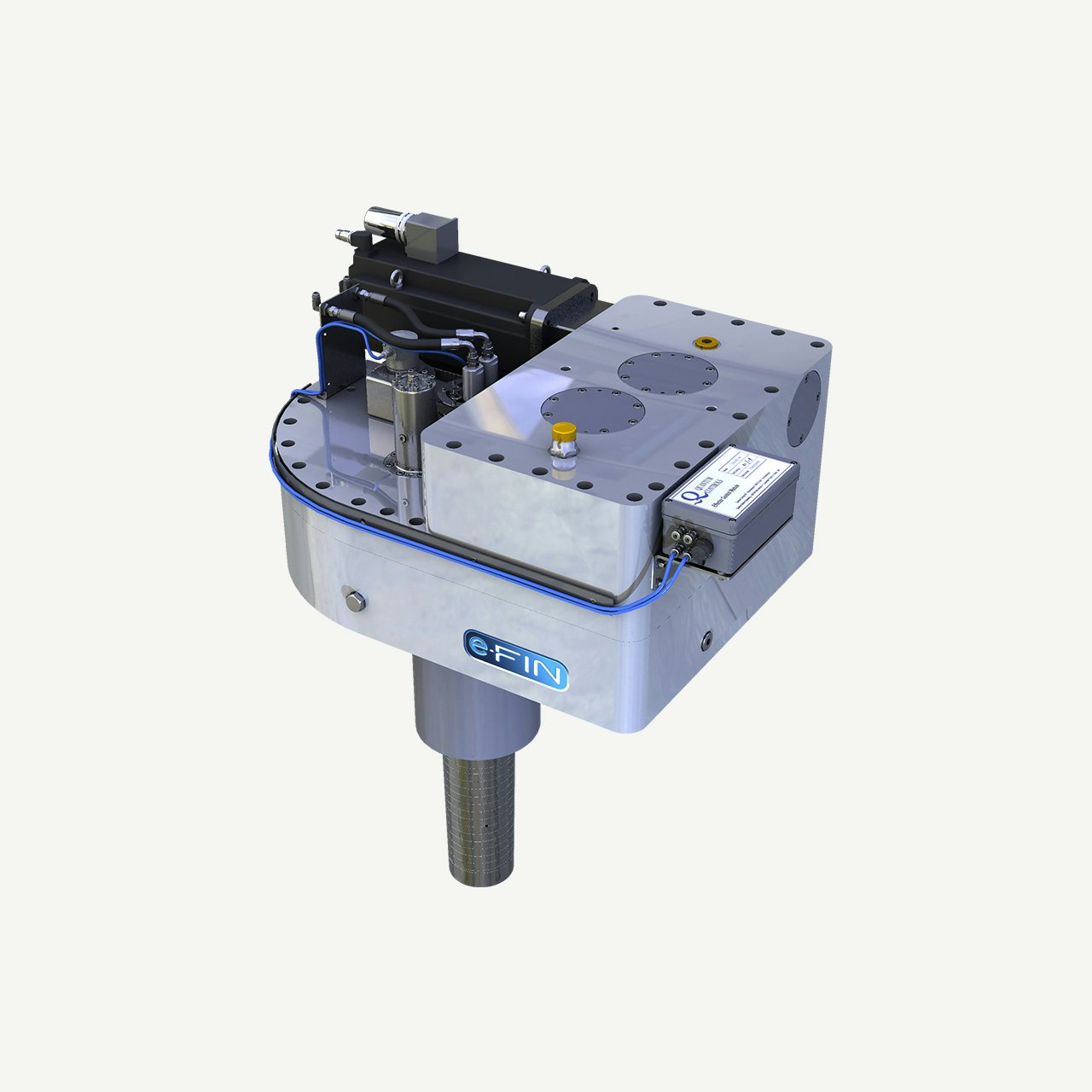


Smaller hull unit & fewer components to install
The smaller size of the hull unit compared to a traditional hydraulic unit, along with fewer components, makes the e-FIN™ easier and faster to install and service.
The e-FIN™ is Quantum’s first-ever fully electric stabilization system, marking another innovative chapter in the company’s history. The original design, purpose-built gearbox and energy recovery capabilities make it unique to other electric stabilizers on the market. In addition, it checks the sustainable solution criteria and positions Quantum back into the 40m – 65m market.
The design of the e-FIN™ is a collaboration between 15 of Quantum’s in-house Hydrodynamics Engineers, Naval Architects, Control Engineers, Electrical Engineers, and Mechanical Engineers from the The Netherlands and the US.
The Design Team set out on a mission with one goal in mind, to build the best performing electric stabilizer possible. Using a “clean sheet of paper” approach and avoiding comparisons to the competition, the team was left with zero boundaries and no constraints.
The new E6 Control is similar to the latest 5000S platform, with a touch screen interface and modular programing for independent functionality. Both controls also use the latest system software and have an active maintenance algorithm.
The E6 uses Quantum’s 25 years of control technology experience to optimize the e-FIN’s algorithms.
The e-FIN™ is considerably more efficient due to the capacitors for power storage. Stabilizers generate large fluctuations when they are moving versus stationary, causing cyclical loading to the ship’s grid. One of the key features is that the e-FIN™ storage system can be charged when the fin movement is low, and discharge energy to the drive motor when fin movement increases. Furthermore, in underway mode, the fins can generate power that can be stored for future use.
Capacitors were chosen for the following reasons:
Power Supply & Recovery System
Hull Unit
XT™ Fin
Select a feature above to learn more
Advantages & Features
The e-FIN™ offers the latest in stabilization design and engineering and comes with numerous advantages compared to a traditional hydraulic system.
The smaller size of the hull unit compared to a traditional hydraulic unit, along with fewer components, makes the e-FIN™ easier and faster to install and service.
The e-FIN™ is considerably more efficient due to the electrolytic capacitors for power storage. Stabilizers generate large fluctuations when they are moving versus stationary, causing cyclical loading to the ship’s grid. One of the key features is that the e-FIN™ storage system can be charged when the fin movement is low, and discharge energy to the drive motor when fin movement increases. Furthermore, in underway mode, the fins can generate power that can be stored for future use.
The purpose-built gearbox is capable of handling up to 10 million cycles.
Expected to run up to 15,000 hours between service intervals.
Due to fewer noise generating components and the optimized gear design.
No cooling required due to the efficiency of the system.
Energy storage system to reduce power fluctuations common to all stabilizer operations.
Plug and play operation.
Compliant with EEE45 rules, DNV, Lloyds and ABS and CE Certified.
Best weight to torque/power ratio.
History
2012 – First R & D Study on Electric Fins
Quantum’s pursuit of developing an electric fin system began back in 2012, with a comprehensive, R & D project that was conducted at Quantum Controls in The Netherlands. There were some key design elements that created challenges such as noise, the power storage system and a reduction gearbox that could withstand both the extreme marine environment and dynamic forces generated underwater. The results of the study, at that time, were less than favorable. In 2014 the project was terminated, and while there were clearly lessons learned, the focus shifted away from electric, to enhancing the capabilities of Quantum’s existing product line.
2023 – Second R & D Study on Electric Fins with Exceptional Results
In 2023, Quantum made the decision to revisit the electric fin concept, examining its potential, using today’s technology. Due to the improvements of power storage systems, in addition to advancements in mechanical and electrical components, the new version of the e-FIN™, showed promise. The prototype underwent months of rigorous testing to validate its viability market readiness. In 2025, the e-FIN™ was officially launched!
The new Quantum e-FIN™ can be installed on a newbuild or retrofitted on an existing vessel. It represents a great addition to the Quantum product range, enabling not only a fully electric solution, but also an ideal system for smaller vessels.
While 80% of yachts over 70m are fitted with a Quantum hydraulic system, the e-FIN™ is the perfect solution for both yachting and military platforms in the 40 – 65m range.
e-FIN™ Size Range
The e-FIN™ creates an opportunity for Quantum to reenter the 40–65m market segment. Over the past 10–15 years, Quantum’s primary focus has been on yachts ranging from 60–200m, with many projects exceeding 100m.
E-FIN™ Fin FAQs